The Beginning of Modern Metal
1980
We may earn an affiliate commission if you make a purchase after clicking on links from our site. Learn more
Help Support Metal Nerdery https://www.patreon.com/metalnerderypodcast
Listen on iTunes, Spotify, Podbean, or wherever you get your Podcasts.
Leave us a Voicemail to be played on a future episode: 980-666-8182
Follow us on the Socials:
Facebook - Instagram - TikTok
Can’t be LOUD Enough Playlist on Spotify
Metal Nerdery Munchies on YouTube
The year is 1980.
The U.S. National Debt is a paltry $900 Billion, the word “yuppie” appears for the first time in print, the Pac-Man videogame is released in arcades everywhere, Mount St. Helens explodes in Washington state, and Cable News Network (also known as CNN) becomes a thing.
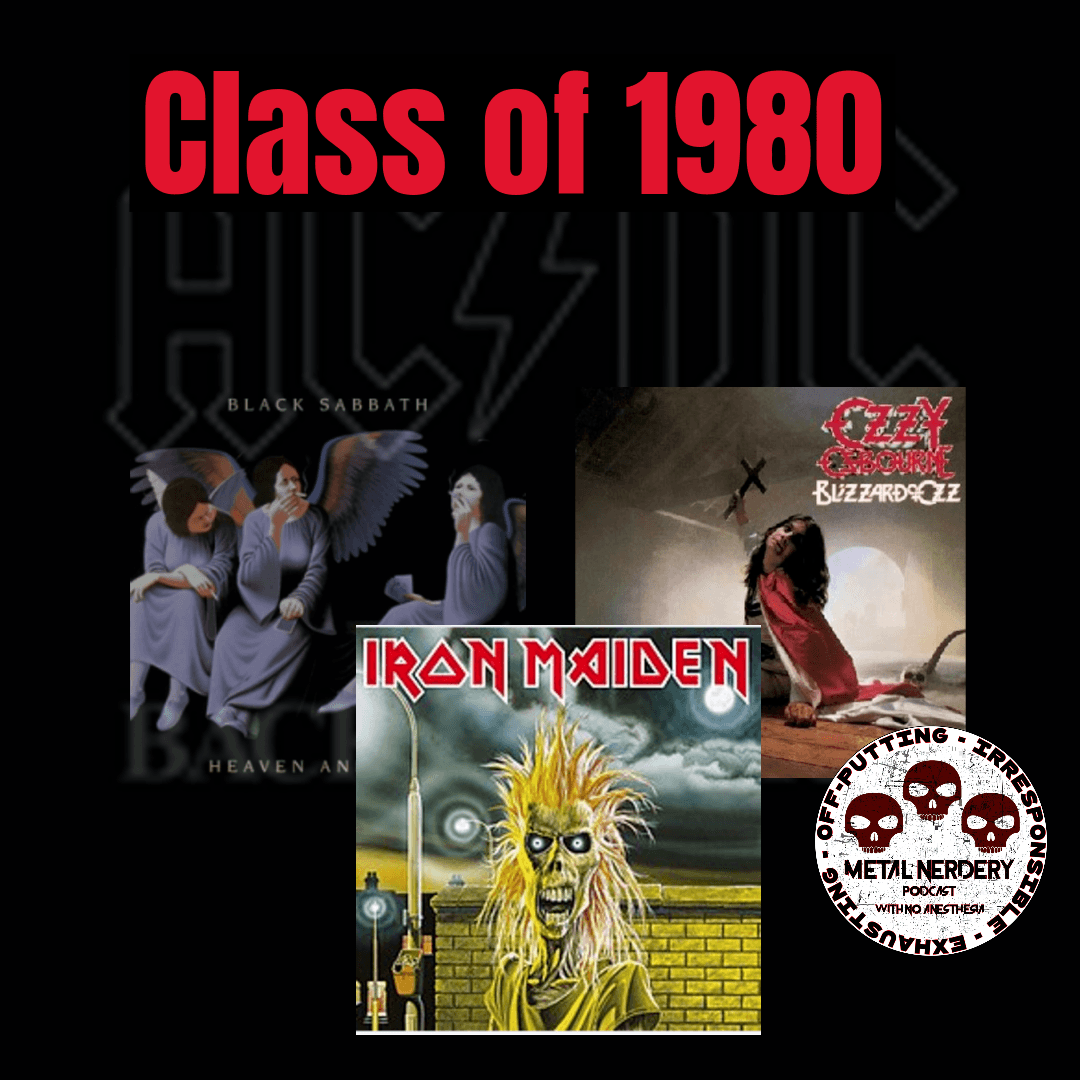
In the world of metal, Iron Maiden release their self-titled debut album, Black Sabbath reinvent themselves with new frontman Ronnie James Dio on vocals and release Heaven and Hell, and AC/DC regroup after the tragic loss of Bon Scott and release Back In Black featuring new vocalist Brian Johnson, an album that would go on to sell more than 40 million copies and become one of the biggest selling albums of all time.
Just as time and technology continued marching forward, the hard rock of the 70’s continued its evolution into a new direction with a faster, heavier, and more aggressive sound beginning in 1980 that would become even faster, heavier, and more aggressive throughout the 80’s.
Before 1980, heavy metal had pioneers. After 1980, it had a movement. In a single calendar year, AC/DC, Iron Maiden, Judas Priest, Motörhead, Saxon, Diamond Head, Angel Witch, Black Sabbath, and Ozzy Osbourne all released albums that didn't just define their own careers — they defined what metal would become for the next four decades. This is the year the New Wave of British Heavy Metal exploded out of pub basements and onto the world stage — and the year AC/DC quietly released what may be the greatest comeback album in rock history.
Black Sabbath and Judas Priest had already put metal on the map throughout the 1970s. But 1980 was the year metal stopped being a handful of bands and became an entire ecosystem. The New Wave of British Heavy Metal — a term coined by Sounds journalist Geoff Barton in 1979 — went from a regional UK phenomenon to a genuine global movement in the space of twelve months.
The scale of what happened is genuinely staggering. Debut albums from Iron Maiden, Def Leppard, Diamond Head, and Angel Witch all arrived in the same year as career-defining, "shock treatment" albums from established acts like Judas Priest, Saxon, and Motörhead. Bands that had been playing pubs and small clubs the year before were suddenly headlining festivals and charting nationally.
The compilation that started it: EMI released Metal for Muthas on February 8, 1980 — a compilation that gave the entire NWOBHM concept major-label legitimacy. It featured some of Iron Maiden's earliest recorded material alongside Praying Mantis, Angel Witch, Sledgehammer, and several other up-and-coming acts. The compilation reached #12 on the UK charts and spawned an actual concert tour, with Iron Maiden headlining.
The Essential Albums of 1980
The audition that changed rock history: Brian Johnson was 32, recently separated, running a small car-repair business in Newcastle, and feeling completely washed up when he got the call to audition for AC/DC in March 1980. He'd been the singer of glam rock band Geordie a decade earlier — a band Bon Scott himself had seen and admired. Johnson's audition rendition of "Whole Lotta Rosie," a song deeply associated with Scott, won the band over within days. The title track "Back in Black" — often mistaken for Johnson introducing himself to the band — was actually written as a tribute to Scott, with Mutt Lange and the band insisting the lyrics be a "celebration" rather than something morbid.
The band that wasn't a band: Blizzard of Ozz was originally intended to be billed as a group called "The Blizzard of Ozz" with Ozzy's name in smaller print — at Reading Festival in 1980 they were even billed simply as "Ossie Osborne's New Band." But by the time the album hit shelves, "Ozzy Osbourne" appeared in much larger type than the band name, effectively rebranding it as a solo album. According to bassist Bob Daisley, this set the tone for everything that followed — Randy Rhoads, Daisley, and drummer Lee Kerslake were eventually written out of the credits and artwork entirely on the 2002 remaster, despite contributing heavily to the songwriting.
Metal for Muthas (February 8) — The compilation that gave NWOBHM major-label credibility, featuring early Iron Maiden recordings. Reached #12 on the UK album charts.
The Heavy Metal Barn Dance — A legendary one-off festival at Bingley Hall in Stafford, headlined by Motörhead, with Saxon, Girlschool, Vardis, Angel Witch, and Mythra all on the bill. A snapshot of just how deep the NWOBHM talent pool ran in a single year.
The American breakthrough — 1980 was also the year NWOBHM started crossing the Atlantic. Motörhead's Ace of Spades was the band's first album released in the US. Despite predating the NWOBHM tag, Motörhead is still considered part of the movement due to their massive influence on it.
What Came Next
The ripple effects of 1980 reached far beyond the UK. Bands like Metallica, Slayer, Mötley Crüe, and Pantera all formed within a year or two of this explosion, directly drawing on the template NWOBHM had just established. Diamond Head in particular would go on to be covered extensively by Metallica, who treated them as essential influences rather than just contemporaries.
By the early 1980s, some NWOBHM bands began crossing into the mainstream — Def Leppard teamed up with producer Robert "Mutt" Lange for a run of massive hits, and Iron Maiden found a new gear entirely with 1983's The Number of the Beast, bringing Bruce Dickinson into the fold. But none of it happens without the foundation poured in 1980.
🏆 Was 1980 the single greatest year in heavy metal history?
Compare it to 1986 — Master of Puppets, Reign in Blood, Peace Sells — and you have two legitimate contenders for the best year metal ever had. 1980 has volume and movement-building significance. 1986 has three albums many call the greatest of all time. Which matters more?
🥊 Iron Maiden's debut or British Steel — which 1980 album aged better?
Steve Harris has never been fully happy with the production on Iron Maiden's debut. British Steel is tighter and more polished. But does raw energy beat polish when you're talking about a genre-defining debut?
🎸 Saxon's two 1980 albums — Wheels of Steel or Strong Arm of the Law?
Most critics give the slight edge to Wheels of Steel for its singles and chart performance. But Strong Arm of the Law has its own passionate defenders. A genuine coin-flip debate from a band that somehow released two classics in one calendar year.
💀 Diamond Head — the most influential "non-famous" band in metal history?
They couldn't get a major label deal and self-released their debut in a blank white sleeve. Yet Metallica built entire chunks of their setlist on Diamond Head covers. Is there a more under-appreciated influence in all of metal?
🖤 Is Back in Black the single greatest comeback album in rock history — full stop?
A band loses its frontman to a tragic death, considers breaking up entirely, and five months later releases what becomes the second best-selling album of all time. Compare that to any other comeback story in music — does anything top it? And does Brian Johnson get enough credit for stepping into an impossible situation and delivering immediately?
🔥 Blizzard of Ozz vs Heaven and Hell — whose 1980 comeback was greater?
Both Ozzy and Black Sabbath spent 1980 proving they could thrive after splitting from each other. Ozzy introduced the world to Randy Rhoads. Sabbath introduced the world to Dio-era Sabbath. Both albums became foundational. Which comeback actually mattered more to metal's trajectory?
Related Metal Nerdery Episodes
Get ready for a taste of “Something Haunted” from the “Necronomidonkeykongimicon” and find out why “you gotta watch for the flops” if you want to get in the spirit and enjoy the FIFA World Cup.
Discover which dinosaur is “the biggest dinosaur”, understand the rules and regulations regarding “flip-flops”, find out which type of rooster has the best breasts, and be sure to “have a nice June” when you JOIN US as we dive headlong into the year that gave us the birth of modern metal with THE YEAR OF OUR RIFF LORD – 1980.
Show Notes:
(00:01): “Welcome back to the red button section of the show…”/ “We’re gonna do an ITM of nothing but Goblin Cock…”/ “They might be on their way to the ATL…”/ The complete #GoblinCock collection / “Necronomidonkeykongimicon…”/ “The dongasaurus…that’s the biggest dinosaur by the way…”/ ***WARNING: #listenerdiscretionisadvised ***/ #AI / #Juicebox / “That’s what I want…please send me a shape shifting sex doll…”/ “One night I might want a home cooked meal…”/ ***WELCOME BACK TO THE METAL NERDERY PODCAST DEEP DOWN IN THE BUNKERPOON CENTER FOR METAL EXCELLENCE!!!*** /
“Consumption is old school tuberculosis…”/ “Okay, so you wanna hear the joke?”/
#cuntscum #scumcunt
(6:55): “Now that we’ve offended everybody…”/ ***PATREON US at patreon.com/metalnerderypodcast *** / “Uh…you missed…”/ “Am I completely wrong or did you miss the Grandmaster Vag Destroyer?”/ “So the song…from Goblin Cock…SOMETHING HAUNTED (Necronomidonkeykongimicon – 2016) / “It’s like hooky doom metal…”/ “Button please…”/ “That was just on #Spotify …”/
***SOCIAL MEDIA US at #metalnerderypodcast on #Facebook #YouTube #Instagram and #TikTok*** / *** EMAIL US at metalnerdery@gmail.com *** / #peachstarfish
(13:13): “I will tell you…how to watch the game ‘soccer’ and be entertained…”/ #FIFA #WorldCupSoccer #WorldCup2026 / “You gotta watch for the flops…that’s the best part…”/ #markthetime / “A good 7 inches…”/ #OzzyManReviews / “These guys KNOW there’s replay…and the internet is forever…”/ “If you want to get in the spirit and watch the world cup, look for the flops…”/ Rules for wearing Flip Flops / #doublefuckyou
(20:00): ***VOICEMAIL US AT 980-666-8182!!!*** / Ken from Connecticut… / #MiltonBerle and #UFO / The dispute regarding AC/DC’s country of origin relative to the band members’ respective countries of origin vs where the band was formed / “Is Scotland England?” / “The band was formed in Australia…”/ NOTE: only Phil Rudd was born in Australia.
(26:08): #TheDocket METAL NERDERY PODCAST PRESENTS: THE YEAR OF OUR RIFF LORD – 1980 (***Also check out our 1980 – THE YEAR IN METAL episode from 2019!***) / “Metal was hard rock and then some, just like death metal was thrash and then some…”/ NOTE: Iron Maiden’s first album is NOT Killers…/ “Remember video games back in 1980?”/ “There’s something to be said about nostalgia…”/ #Atari / “I could still get behind Mario…”/ #markthetime / “It’s June, dude, we can do that…”/ “Adventure? Oh, where the dragon looks like a duck?”/ “Billboard’s Top HOT 100 Songs in 1980…”/ “What’s number uno?”/ “If you put some distortion on Air Supply…hair metal, all day…”/ “It’s June, we can do that…”/ “The Dirt Band?”/ “Let me ask you guys something about Pat Benatar…”/ #premetal / “Especially ‘Hell Is For Children’…”
(34:44): “Them’s fightin’ words, bro…”/ #killeropener / #IronMaiden PROWLER (Iron Maiden – 1980) / “I just noticed something…Paul Di’Anno’s voice…” / #nuanced /
“What about The Black Album of 1980?” / #allegedly / “Did they not remix/remaster Back In Black (the album) not too long ago?”/ “Let’s do a deep cut…”/ #ACDC GIVIN THE DOG A BONE (Back In Black – 1980) / “Oh…dogs like bones…” / “Is AC/DC metal?...it’s close enough…”/ “It was remastered in ’94, ’03, and ’09…”
(41:25): “What about something from Saxon? They had 2 albums that year…”/ “Lars is a big Saxon fan too…”/ #Saxon HEAVY METAL THUNDER (Strong Arm Of The Law – 1980) / “That sounds familiar…”/ “That sounds like old Pantera…”/ “On the #UFO kick…we’ve got No Place To Run…”/ #UFO MYSTERY TRAIN (No Place To Run – 1980) /“Is that Schenker?”/
NOTE: it was NOT Michael Schenker…it was Paul Chapman / NOTE: Pete Way was also in #Fastway and #Waysted / “That’s the other thing about 1980…the artwork…”/ #bodydysmorphia #bodypositivity / #Budgie FOREARM SMASH (Power Supply – 1980) /
“Yep, that’s got metal vibes to it…”/ NOTE: It IS the same guy/singer.
(52:33): “How about some Priest?” / “If your title’s too long it doesn’t get played…”/
“I wonder if that site actually gives Rob Halford a residual?”/ “It’s June…have a nice June…I mean, it’s June…”/ #JudasPriest THE RAGE (British Steel – 1980) / “There was a lot of comments when we did the ’86…this is NOT better than ’86…”/ “People love nostalgia…”/
“Maybe even ’83 I can get…’83 maybe more than ’80…” / “What are you feeding those things?”/ “You could SEE the TASTE of that…”
(1:00:20): “I’ve never heard of Atomic Rooster…”/ “That cock has got some huge boobs on it…I mean it’s June, so…”/ #AtomicRooster FRIDAY THE 13TH (Atomic Roooster – 1970) /
NOTE: #AtomicRooster, the band, released Atomic Roooster (the album) in 1970, the album which included Friday The 13th…the album Atomic Rooster was released in 1980. We apologize for any confusion this may have caused, but to be fair, the 1970 album has a much cooler album cover than the 1980 album does. / “We talk about Bone movies enough…and it’s June…”/ #OzzyOsbourne NO BONE MOVIES (Blizzard Of Ozz – 1980) /
“Context matters…”/ “Animal Magnetism…look at that cover…there’s a dog there too…”/
“I’ll shut up about June…” / #Scorpions THE ZOO (Animal Magnetism – 1980) /
“Not fisting…”/ “You know what, I think he might actually be shorter than Dio…”
(1:08:46): “How about the Tygers of Poon Tang, dude? Or Pang Tang?”/
“I had (a curry) one time that was supposed to be spicy and it literally tasted like halitosis…”/ #debutalbum / “The G is silent…”/ #TygersOfPanTang EUTHANASIA (Wild Cat – 1980) / “Oh yeah…okay?”/ “Very lackadaisical performance…”/ “More metal than Black Sabbath? Or Iron Maiden?”/ “I wanna hear this one…” / #DiamondHead HELPLESS (Lightning To The Nations – 1980) / “That is 7 years before Garage Days came out…isn’t that crazy to think about?” / “And we never really would have known about this band without Metallica…”
(1:16:37): “That’s probably the most metal Van Halen tune…”/ “Oh, it was Mr. Bungle…and they nailed it…”/ #VanHalen LOSS OF CONTROL (Women And Children First – 1980) / “You can almost hear #Pantera doing that…” / #SevenMaryThree #CHiPs / “I think we would be remiss if we did not include something from Heaven and Hell…” / “Molly Hatchet was such a tease…remember what their album covers looked like?”/ #BlackSabbath DIE YOUNG (Heaven And Hell – 1980) / NOTE: It’s Geoff Nichols NOT Don Airey / “Wait a minute…that’s on the first album, right?” / “How we play a little bit of ‘Running Free’ just to compare the riffs…” / #IronMaiden RUNNING FREE (Iron Maiden – 1980)
(1:22:46): “What was the most metal song on ‘Permanent Waves’?” / “Given the Rush fanfare…”/ #Rush NATURAL SCIENCE (Permanent Waves – 1980) / “Very trippy…”/
“The coolest thing I’ve heard somebody say about Rush, especially this era: that album came out 40+ years ago and it STILL sounds like it’s from the future!”/ “They were the first real ‘music nerd’ band…”/ “Whatever…it’s June…”/ The way radio shows were back in the 70’s and 80’s / “I liked ‘Don’t Fear The Raper’…”/ “How about some Angel Witch…is that like a Sand Witch?”/ #AngelWitch ANGEL WITCH (Angel Witch – 1980) / “It’s like uppity, happy metal…”/ “If we’re gonna do a death match between years…”/ “We need to start setting up #SpotifyPlaylists of what we do on the show…”/ THANK YOU FOR JOINING US!!! / #untilthenext #outroreel